NARRATIVES III
Opening: Monday, 7 September 2026, 7 p.m.
Opening speech: Klaus Speidel
On Saturday, October 3: The wuk is celebrating its 45th birthday. We’re participating with:
Guided exhibition tour: Johan Nane Simonsen: 2.00 p.m.
Lecture-performance: Investigations into the Future, Margit Busch: 3.00 p.m.
The gallery will be open that day during its regular hours, from 1:00 p.m. to 5:00 p.m.
Duration of the exhibition: 8 September–10 October 2026
Finissage & catalogue presentation: Saturday, 10 October 2026
For 2025/26, the curatorial team of FOTOGALERIE WIEN has chosen to focus on NARRATIVES, exploring narrative strategies and structures in contemporary photography and video art. The three exhibitions developed for this theme are organised chronologically: The first part, Topographies of Memory, looks back at the past through an examination of archival material, histori-ography, and collective and individual memory. The second part, Forms of the Present, addresses the question of how digital media can inform new narrative modes, and considers the over-whelming number of constantly available narratives in a networked world. The third part – Alternative Ending – looks to the future and is dominated by visionary, fictional and speculative narrative modes, which are based on a desire to perceive the world differently or to escape it. Linear and unambiguous narrative struc-tures are replaced in the artistic works of the three exhibitions by discontinuous, fragmentary and circular representations, or those that lie between documentation and construction. Expectations are broken, and entrenched narratives are disrupted or dissolved in favour of multi-perspective narratives. There is also a focus on storytelling itself: what is told, by whom, and how, and how meanings, language and communication.
According to Robert Musil, “possibilitarians” possess a sense of possibility—namely, the ability “to conceive of everything there might be just as well and to attach no more importance to what is than to what is not.” Anyone who speaks of what there might be speaks, also regularly, of the future. The works in the exhibition NARRATIVES III can also be interpreted in this way. They employ documentary, speculation, probing (and exploration), or ritualistic approaches.
Vik Bayer’s two-channel documentary video installation Losing Futures (Slo-Mo Visions of Refusal of Unfulfilled Promises) traces the history of a Sicilian consortium that produces avocados and lemons, outlining its ideological foundations within the context of the global market economy and the local social fabric. The work addresses planetary, ecological, and historical developments alongside the local reality of an ecosystem under pressure—where avocado trees are damaged by wildfires and olive trees adapted to arid conditions still wither because rapidly evaporating water causes irreversible cellular damage. Visually and—at times—acoustically, the work shifts the focus away from the human, almost completely obscuring faces so that human agency does not consistently appear more important than nonhuman agency.
Whilst Bayer’s work outlines a possible utopia of solidarity-based consumption that could make Earth a more livable place, Ralo Mayer’s 2022 print Un·Earthing (playsuit for Mars) addresses the escapist fantasies of Silicon Valley’s techno-oligarchs, whose blind spot is the lives of and with children and the associated care work. The photograph shows the testing of a prototype playsuit that would be utterly unsuitable for Mars, its disrupted pattern serving as an allegory. It was taken in the 50-kilometre-wide Ramon Crater in the Negev Desert. Due to its resemblance to the Red Planet, the crater regularly serves as the setting for Mars mission simulations involving ‘analogue astronauts’.
Kay Walkowiak’s 2023 video Encounters also represents a form of experiment. However, it is not concerned with a potential future for humanity beyond Earth, but rather with the relationship between nonhuman beings and human-made works. The only living creatures seen in the video are monkeys interacting with painted panels. By taking hold of the panels—yet viewing them only from odd angles and, in particular, licking them extensively—they unsettle aesthetic assumptions underlying a human-centered understanding of art.
A nonhuman form of existence also becomes an active agent in Angelika Loderer’s Exposure. In this work, photographic prints depicting endangered species, precarious places, and human relationships are slowly overgrown by a fungal network, causing the original images to blur or disintegrate. When molds take over human artifacts, this is usually perceived in human-centered contexts as purely destructive. Loderer’s work makes this visible as a process of transformation that also becomes aesthetically productive. By exposing the developed images to the fungi, she turns destruction into new creation—perhaps even co-authorship. In doing so, she encourages a new way of looking at the actions of nonhuman agents more broadly, allowing her work to resonate with that of Vik Bayer and Kay Walkowiak.
Rio -Roberta Lima explores another way of engaging with the world and—with the focus of this exhibition in mind—shaping the future. The photographs and excerpts from performance videos presented at FOTOGALERIE WIEN are reminiscent of ritualistic practices. Here, too, non-human entities become “social agents” in the sense proposed by anthropologist Alfred Gell. However, the performers do not interact with living beings, but with blocks of ice, sublimating dry ice, or suspended spheres of ice. Alfred Gell views agent-patient relationships as dynamic: when the chandelier made of ice spheres drips, it acts as an agent upon the performers, who in that moment become patients. When they then lick up the water or sever the suspensions holding the spheres, the water and ice, in turn, become patients. Lima’s interactions with water and CO2 in various states of matter—solid, liquid, and gaseous—and her play with the transitions between them (freezing, melting, sublimating) evoke unstable, open-ended relationships among diverse entities. The performers’ actions oscillate between the experimental, the playful, and the ritualistic, ultimately remaining open to interpretation.
Like these, the works in the exhibition evoke possible futures primarily through various interactions between human and nonhuman agents. In doing so, they treat “possible realities” with the same seriousness as “real possibilities”, thereby gently sketching out possible utopias.
-
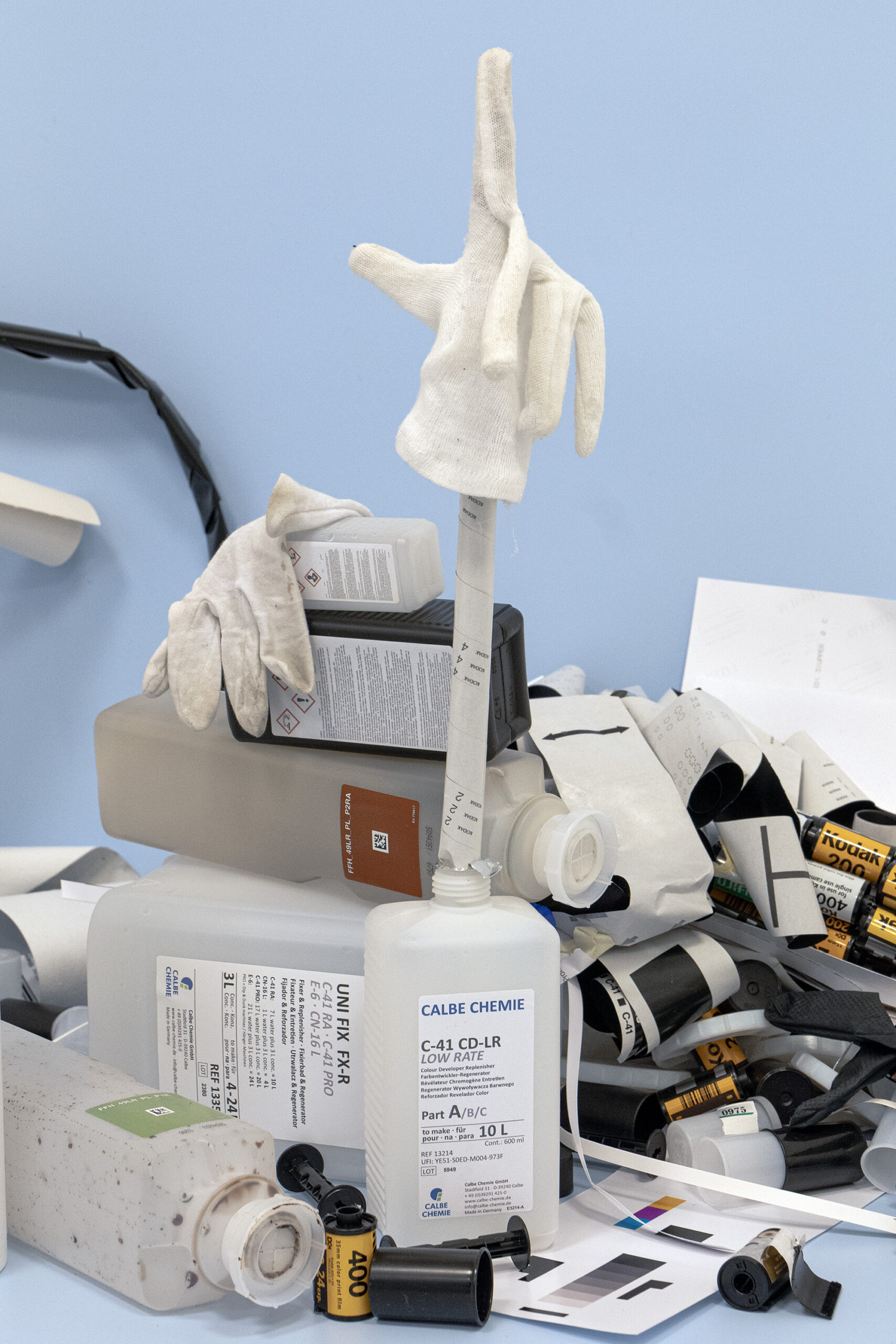
DISPLAY CABINET V: Anna Lerchbaumer
10. March 2026 — 10. October 2026
Opening: Saturday, 7 March, 7 p.m. Finissage and publication presentation: Saturday, 10 October 2026, 7 p.m. DISPLAY CABINET is an exhibition situation created in 2023 in the entrance area of FOTOGALERIE WIEN. Every six months, installations or interventions will take place in the space. The fifth intervention will be designed by the artist Anna Lerchbaumer. […]
-
8. September 2026 — 10. October 2026
NARRATIVE Ⅲ
Alternative Ending
Opening: Monday, 7 September, 2026, 7:00 pm
Duration: 8. September – 10. Oktober 2026
Finissage & Catalogue Presentation: 10 October 2026