NARRATIVE II

Opening: Monday, 16 March 2026, 7 p.m.
Opening speech: Christina Natlacen

For 2025/26, the curatorial team of FOTOGALERIE WIEN has chosen to focus on NARRATIVES, exploring narrative strategies and structures in contemporary photography and video art. The three exhibitions developed for this theme are organised chronologically: The first part, Topographies of Memory, looks back at the past through an examination of archival material, historiography, and collective and individual memory. The second part,
Present Forms, addresses the question of how digital media can inform new narrative modes, and considers the overwhelming number of constantly available narratives in a networked world. The third part looks to the future and is dominated by visionary, fictional and speculative narrative modes, which are based on a desire to perceive the world differently or to escape it.
Linear and unambiguous narrative structures are replaced in the artistic works of the three exhibitions by discontinuous, fragmentary and circular representations, or those that lie between documentation and construction. Expectations are broken, and entrenched narratives are disrupted or dissolved in favour of multi-perspective narratives. There is also a focus on storytelling itself: what is told, by whom, and how, and how meanings, language and communication change.

Our society has long since entered a post-narrative world. In place of the grand, identity-forming narratives of modernity, we are exposed to a ceaseless “tsunami of information” (Byung-Chul Han). The manic accumulation of data and the incessant noise of communication have taken the place of narrative as a constitutive force of community. NARRATIVE II: Present Forms brings together artistic works that take up these phenomena of our digital reality, critically examine them, but also turn them on their head. As counter-models to our mediatized everyday world, they possess an inherent poetic power capable of producing new narrative forms.

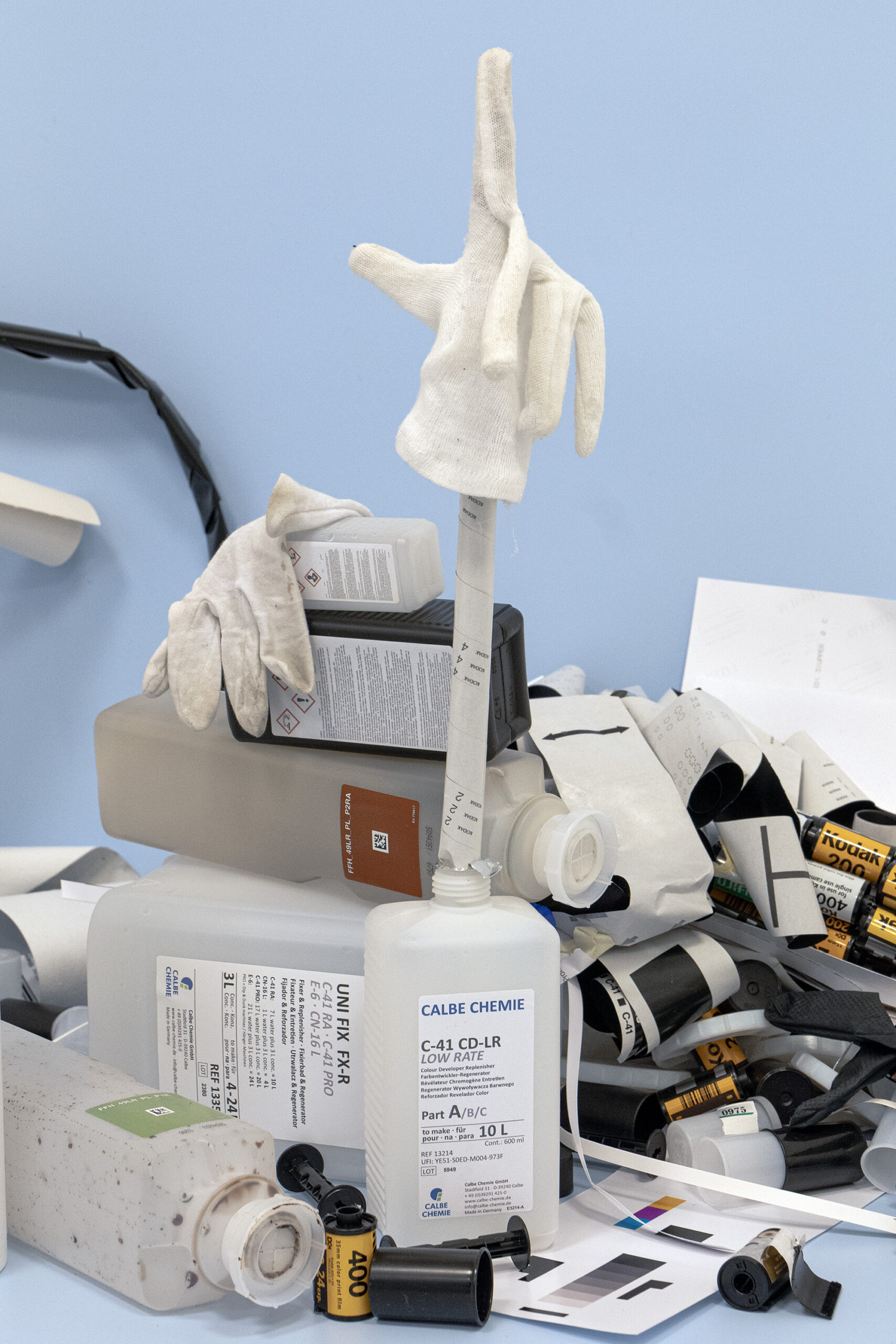
Benjamin Friedle, in Worte aus Bildern aus Fotos aus Formen, explores the surface of contemporary life, where the lines between the digital realm and reality are increasingly blurred. Presented in three parts, selected narratives revolving around the medium of photography are interwoven into a complex tapestry: Worte aus Bildern links personal observations on the pervasive influence of photographic discourse on everyday language with theoretical reflections; Bilder aus Fotos overwrites photographs of specific locations with finely detailed AI-generated variations; while Fotos aus Formen consists of casts of photographic infrastructures – from developing trays to hard drives. The work reveals that abstract processes such as probabilities and algorithmic decisions have increasingly become constitutive elements of contemporary image production.

Chantal Kaufmann’s multi-part video Imagine Language (Day_00, Day_03, Day_01) explores language – the cornerstone of every narrative – and its relationship to the image. Presented are three distinct forms of meaning production: first, a pre-linguistic mode grounded entirely in the rhythm of images; second, words displayed instantly the moment a syntax emerges; and third, the linking of image and text through an open-ended subtitle layer. A stream of fragments of reality rushes past the viewer’s eyes at breakneck speed, inviting them to let their own memories and associations run free.

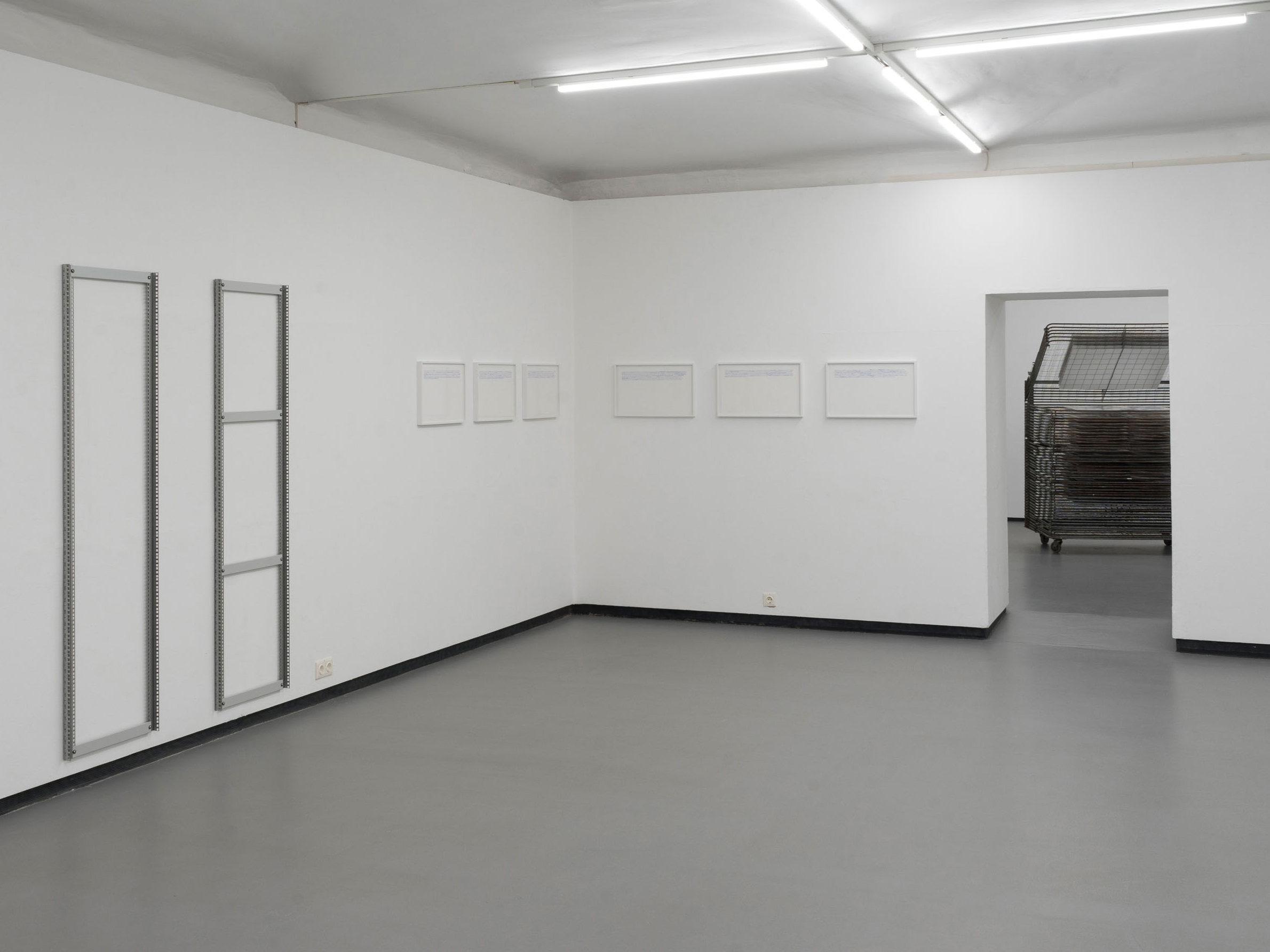
Ulrich Nausner’s series of works, Memory Objects (grey), consists of standardized mounting rods and cover plates used for housing servers in large data centers. Taken directly from everyday life without significant modification, they reference a specific content (data/storage) through their particular identity (server rack), but their form is so reduced here their meaning can only be clearly deciphered via the title. The large-scale wall installation is paired with the new work Tag Clouds, in which clusters of words gleaned from selected books on the art of language and media theory are decontextualized in pigment prints, transforming them into works of concrete poetry.

Mara Novak’s work Pocket Fotogalerie recreates the exhibition space as a 1:200 scale model, turning it into a camera obscura via pinholes. The “dark chamber” functions not only as an exhibition object but also as an instrument for actively producing images, inside of which photographic paper is exposed. The outcome is a representation of the actual space that also involves visitors in the photographic process. The photographs, created through a direct positive process and developed on-site in a temporary photo lab, are visually detached from reality: they are an abstract representation of the gallery space as well as a schematic plan of the architectural structure.

Amar Priganica & Philipp Zöhrer present with their work Be Not Afraid a sound sculpture whose ethereal tones evoke the supernatural. A black-painted loudspeaker is mounted in a corner of the room – the location where Russian Orthodox icons are traditionally displayed and which Kazimir Malevich deliberately chose for his famous abstract painting. It is as if the emanating sounds were revealing something – and yet, despite the jubilation, the proclamation, and the prophecy, there is hardly anything to say. The black hole twists narratives, sucks them in, relativizes, and destroys them. Messages resound without any discernible origin, without dialogue, without meaning – the only crucial factor is that the message is transmitted.

Jenny Schäfer’s artist’s book and wall work Jede Hand ein Oktopus invite viewers on a quest for a contemporary Atlantis amidst sunken ruins, decorative faux antiques, and underwater fantasies. Drawing on ancient mythology, the works unveil, like a kaleidoscope, a variety of contemporary narratives that engage with Atlantis. These range from pop-cultural references and childhood fairytale worlds to escapist dreams and politically motivated conspiracy theories. Such narratives conjure up secret elites, notions of “lost purity,” or superior civilizations. Accordingly, they can skew toward right-wing ideologies that make use of a mythical past to legitimize exclusionary worldviews.

Noyan Tuna – against the backdrop of an ever-accelerating present, where data streams and sensational headlines never cease – sets out with his analog handheld camera in search of places where the human dimension is still preserved. His film, Notes to Myself, reveals itself as a poetic travelogue about walking, pausing, and consciously arriving in a world that never stops. Between strides, spaces of silence open up – moments in which freedom and humanity can be felt once again. Under the distant pressure of conflicts, the film shows how moments of pause can act as a gentle rebellion against the relentless advance of the world.

(Christina Natlacen)